Showing posts with label World War I. Show all posts
Monday, November 17, 2014
Tuesday, January 22, 2013
The Horns of the Buffalo
In preparation for our visit to the WW1 sites, CDB focuses on Yiddo’s visit in 2010 to the site of one of the British Empire’s most comprehensive and devastating military defeats.
This event took place at Islandwana in Zululand on this date in 1879, one hundred and thirty-four years ago.
To drive to Rorke’s Drift (scene of another heroic battle several days later) from Durban one must pass through some particularly difficult terrain and if the Yiddo family found it a challenge in a four-wheel drive in 2010, one can only imagine what it was like when Lord Chelmsford led a force of 5,000 British troops there in January 1879.
The intent was to drive into Zululand and subdue the locals armies (led by King Cetshwayo) – a motive which was partly expansionist and partly protectionist - Zululand bordered onto the British colony of Natal and there were fears as to the threat created by the local chiefs.
Having set-up camp under the distinctive sphinx-like hill called Islandwana, Lord Chelmsford made the mistake of splitting his force and sending the main body (with himself in command) in a misguided pursuit of the Zulu army. The main body of Zulus were actually hidden behind Islandwana and at 11am on the 22 January 1879 they advanced on the remaining British force. The encirclement tactic employed by the Zulus was known as izimpondo zankomo, translated as “The Horns of the Buffalo”, a description of the movement of the victorious army as the centre is sacrificed or strategically deployed to allow an encirclement to take effect.
The British forces lost 1,350 men – 1,000 of their own and 350 local auxiliaries. The battle at Isandlwana stunned the British Empire and indeed the world. It was heretofore considered inconceivable that a primitive local army, ill-equipped - stabbing weapons only, could so comprehensively defeat the troops of a western power armed with modern rifles and artillery.
In the Ardennes and at Ypres we shall see white crosses commemorating the fallen – at Islandwana the last standing place of the British soldiers is marked with a mound of white stones, in keeping with local burial traditions.
The political ramifications of the defeat were significant and the recriminations over war-mongering and incompetence led to discord between the Prime Minister at the time, Disraeli and Queen Victoria. This by all accounts was a rare event. Chelmsford was recalled and in a strong position as a survivor, as opposed to one of the fallen, is reputed to have discredited one of the dead – Colonel Durnford whom he maintained did not send distress messages to the main British force from the besieged camp.
Queen Victoria supported Chelmsford’s position, Disraeli who felt the Zululand incursion was always a mistake, had opposing views and this lack of accord may have contributed to Disraeli losing the 1880 election a year later.
Chelmsford, with Royal privilege, lived to the age of 78 and died playing snooker at his gentleman’s club in London in 1905.
Tuesday, November 20, 2012
The Poppy - editorial response
Dear Colonel,
I refer to yours of the 20th inst.
The article in CDB did as intended - it provoked dialogue and discussion, without fully addressing all of the issues associated with the wearing, or otherwise, of the poppy. .
There are other worrying dichotomies which arise when considering the matter. The first I would like to highlight is the "charitable status" achieved by the organisations promoting the sale of the flower. I find it slightly disconcerting to think that the money spent on purchasing the badges is used to support the war-injured (or simply the war-veterans) who have served in the British Army. If their own Government, which determined which causes they would die for, will not provide appropriate support, then why should we? A troubling angle to the issue which is compounded by the fact I may not agree with their chosen causes - a point you rightly make.
Secondly, the poppy is worn on the 11th of November, Armistice Day, and as such it commemorates the outbreak of peace. Peace which came in a war that counted 16.5 million deaths, of whom 1.0 million were from the United Kingdom. The remaining 15.5 million came from a multitude of countries, six of whom individually had a greater number of casualties than the UK. In these circumstances it seems a shame that the wearing of the poppy in our country has been associated with a pro-British allegiance, when clearly it represents so much more. Maybe in turn this is attributable to the first point I make - the adoption or hijacking of the poppy by the British war veterans groups and charities.
I wore the poppy on the 11th. Part of that decision was driven by the same belief James McClean was displaying - a belief in free speech and self-determination I wasn't challenged on the day nor did I receive any snide comments - this surprised and, I hate to admit, partly disappointed me. Maybe at the end of the day there is hope.
Thanks you for your letter - this matter will obviously require further debate after we listen to the Last Post at Ypres in February next year. I look forward to that dialogue.
Yours, etc,
Ed.
I refer to yours of the 20th inst.
The article in CDB did as intended - it provoked dialogue and discussion, without fully addressing all of the issues associated with the wearing, or otherwise, of the poppy. .
There are other worrying dichotomies which arise when considering the matter. The first I would like to highlight is the "charitable status" achieved by the organisations promoting the sale of the flower. I find it slightly disconcerting to think that the money spent on purchasing the badges is used to support the war-injured (or simply the war-veterans) who have served in the British Army. If their own Government, which determined which causes they would die for, will not provide appropriate support, then why should we? A troubling angle to the issue which is compounded by the fact I may not agree with their chosen causes - a point you rightly make.
Secondly, the poppy is worn on the 11th of November, Armistice Day, and as such it commemorates the outbreak of peace. Peace which came in a war that counted 16.5 million deaths, of whom 1.0 million were from the United Kingdom. The remaining 15.5 million came from a multitude of countries, six of whom individually had a greater number of casualties than the UK. In these circumstances it seems a shame that the wearing of the poppy in our country has been associated with a pro-British allegiance, when clearly it represents so much more. Maybe in turn this is attributable to the first point I make - the adoption or hijacking of the poppy by the British war veterans groups and charities.
I wore the poppy on the 11th. Part of that decision was driven by the same belief James McClean was displaying - a belief in free speech and self-determination I wasn't challenged on the day nor did I receive any snide comments - this surprised and, I hate to admit, partly disappointed me. Maybe at the end of the day there is hope.
Thanks you for your letter - this matter will obviously require further debate after we listen to the Last Post at Ypres in February next year. I look forward to that dialogue.
Yours, etc,
Ed.
The Poppy - your letters
Dear Sir
I refer to your article in CDB regarding the decision of McLean not to wear a poppy in the recent game against Everton. While your article sought to highlight the sensitivities underlying such a decision I fear it overlooked key aspects. Firstly and fundamentally those who died in the Great War and the 2nd World War did so to preserve fundamental freedoms including the right of free speech and expression. James McLean was exercising that right as much as any of the thousands who chose to wear the poppy. Secondly, but I suspect first and foremost in the mind of Mr Maclean, the poppy , so long as symbol of those who died at the Somme, has in the last 10 years been promoted as a symbol of the British Army in all its endeavours including needless wars in Iraq and Afghanistan. While I would be proud as an Irish man to wear a poppy in memory of those who gave up their lives in order to preserve European democracy I would be horrified to think that such a gesture would be interpreted as being support for the wholly undemocratic campaigns being waged by successive British governments in the recent past. I suspect that Mr Mclean, as your article suggests, has good reason to disassociate himself with such campaigns particularly those whose sole objective is to defend and maintain an imperial presence in a territory where he sought to eke out an existence despite horrific discrimination inspired by raw bigotry.
For you information I chose not to wear a poppy but, on the 11th of November, I did stand by the grave of my uncle who gave his life in the in 1917.
Yours Sincerely
The Colonel
I refer to your article in CDB regarding the decision of McLean not to wear a poppy in the recent game against Everton. While your article sought to highlight the sensitivities underlying such a decision I fear it overlooked key aspects. Firstly and fundamentally those who died in the Great War and the 2nd World War did so to preserve fundamental freedoms including the right of free speech and expression. James McLean was exercising that right as much as any of the thousands who chose to wear the poppy. Secondly, but I suspect first and foremost in the mind of Mr Maclean, the poppy , so long as symbol of those who died at the Somme, has in the last 10 years been promoted as a symbol of the British Army in all its endeavours including needless wars in Iraq and Afghanistan. While I would be proud as an Irish man to wear a poppy in memory of those who gave up their lives in order to preserve European democracy I would be horrified to think that such a gesture would be interpreted as being support for the wholly undemocratic campaigns being waged by successive British governments in the recent past. I suspect that Mr Mclean, as your article suggests, has good reason to disassociate himself with such campaigns particularly those whose sole objective is to defend and maintain an imperial presence in a territory where he sought to eke out an existence despite horrific discrimination inspired by raw bigotry.
For you information I chose not to wear a poppy but, on the 11th of November, I did stand by the grave of my uncle who gave his life in the in 1917.
Yours Sincerely
The Colonel
Monday, November 19, 2012
What do we make of this?
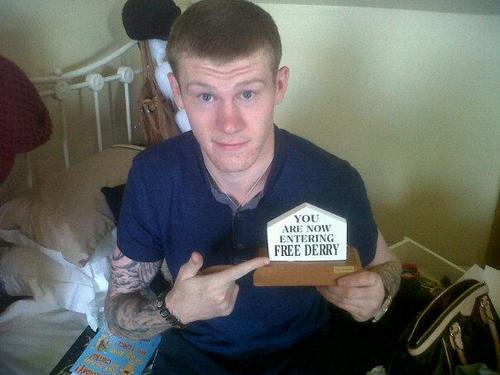
Whatever one thinks about the issues behind wearing the poppy in Ireland – and I chose to wear one - you have to admit that the decision made by James McClean to take the field against Everton the weekend before last wearing a shirt without a poppy was certainly a brave one.
Those who laud his decision to stand alone refer to his upbringing and his closeness to the troubles, citing the fact that several victims of alleged British Army over-exuberance, or murders, lived on the estate where he grew up. The counter argument is that most of McClean’s formative years were in times of peace; that he now is happy to live and make a living in the UK as opposed to staying in Free Derry; and finally that the poppy is as much a remembrance of Armistice Day when peace spread across Europe as it is a tribute to the fallen soldiers in British and other armies.
Despite the courage displayed in making his statement, it is hardly surprising that he was booed by the Sunderland away supporters at Fulham yesterday and it remains to be seen how long he survives at the club, before moving on to a more suitable clime – like Parkhead, where such ill-judged shows of loyalty are regularlry feted by the ignorant masses.
And what of the club's role in all this - always treading a balance presumably between the pampered supperstars and the supporters who pay to put them there. The decision to allow him to take the field without a poppy was a curious one which may alienate local support, and therefore one which must be viewed with a degree of concern by the club’s investors. Oh shit, but I forgot, they’re Irish as well.
Contrast this with the very different approach taken by Hibernian Football Club and reported in today’s Irish Times. “All in the Game” refers to the sacking of the Hibernian Stadium Announcer Willie Doherty for playing the Beatles “Taxman” at half-time to wind up local rivals Hearts because of their well-publicised VAT problems with Her Majesty’s Revenue Commissioners. A petition has been launched to get him re-instated.
A world gone mad.
Friday, November 11, 2011
There's a warm summer breeze, it makes the red poppies dance
Sunday, January 31, 2010
Reading on the toilet
A singular and solitary pleasure.
Yesterday's reading was the Spurs Everton program from October 27 (2-0) with Tommy Huddlestone on the cover. Inside a feature on Walter Tull an ex Tottenham player who it transpires was the first black outfield player in England. Looking at the photographs I couldn't help notice the resemblance between the two players.

Walter was the son of a Baijian father and an English mother but ended up in a London orphanage at the age of 10. His footballing skills resulted in him signing for Spurs in 1909 and he went on to play 18 games for the club, scoring 7 goals. He left Spurs to join Northampton Town and played 110 games for them before World War I called him into active service. His regiment, the 17th (1st Football) Battalion of the Middlesex Regiment was sent to France in November 1915 where they took part in the Battle of the Somme.
Following being invalided out of France, he undertook officer training and returned as a second Lieutenant in the 23rd (2nd Football) Battalion to fight again at the Somme, in the second Battle of the Somme. On March 25, 1918, in no-mans land at Pas de Calais, he was reported to have been shot in the head and he died instantly. His body was never recovered - the memorial at Arras and the cemetery wall at Fauborg Amiens bear his name. He served for close to the entire duration of the war, was mentioned in dispatches for gallantry and was posthumously awarded the British War and Victory medal.
Tommy for his part is 22, likes Beyonce and playing Xbox, earns in excess of thirty five or forty grand a week and is often accusing of being a little bit too lazy on the pitch for his own good.
While it is clearly gratifying to see how far "minorities" have come in the English game over the last hundred years, it's sad to see how far the game itself has moved away from the core values which are, and always have been, its' lifeblood.
It's all gone wrong somewhere, me thinks.
Yesterday's reading was the Spurs Everton program from October 27 (2-0) with Tommy Huddlestone on the cover. Inside a feature on Walter Tull an ex Tottenham player who it transpires was the first black outfield player in England. Looking at the photographs I couldn't help notice the resemblance between the two players.

Walter was the son of a Baijian father and an English mother but ended up in a London orphanage at the age of 10. His footballing skills resulted in him signing for Spurs in 1909 and he went on to play 18 games for the club, scoring 7 goals. He left Spurs to join Northampton Town and played 110 games for them before World War I called him into active service. His regiment, the 17th (1st Football) Battalion of the Middlesex Regiment was sent to France in November 1915 where they took part in the Battle of the Somme.
Following being invalided out of France, he undertook officer training and returned as a second Lieutenant in the 23rd (2nd Football) Battalion to fight again at the Somme, in the second Battle of the Somme. On March 25, 1918, in no-mans land at Pas de Calais, he was reported to have been shot in the head and he died instantly. His body was never recovered - the memorial at Arras and the cemetery wall at Fauborg Amiens bear his name. He served for close to the entire duration of the war, was mentioned in dispatches for gallantry and was posthumously awarded the British War and Victory medal.
Tommy for his part is 22, likes Beyonce and playing Xbox, earns in excess of thirty five or forty grand a week and is often accusing of being a little bit too lazy on the pitch for his own good.
While it is clearly gratifying to see how far "minorities" have come in the English game over the last hundred years, it's sad to see how far the game itself has moved away from the core values which are, and always have been, its' lifeblood.
It's all gone wrong somewhere, me thinks.
Wednesday, November 11, 2009
There's no gas, no barbed wire, there's no guns firing now.....

11am on the 11 November 1918.
I searched for pictures or artwork showing the opposing sides playing football on Christmas Day 1914 but nothing jumped out at me. I also searched in vain for a report on the match which the Germans won on penalties, despite having gone a goal down to a hotly disputed goal (in off the butt of a rifle), awarded by a Russian Kaiser who was miles off the play in downtown Volvograd.
Football - the global game. Choose football. Choose life.
Subscribe to:
Posts (Atom)