Showing posts with label Anti-heroes. Show all posts
Monday, October 15, 2012
Wrap the EU flag around me, boys
Watching Rory McIlroy eagerly grab and drape the EU flag around him a few weeks ago at the Ryder Cup only sought to heighten the controversy surrounding his reluctance to do the same with the Irish flag after winning the US Open in 2011.
While his decision to lean towards representing Great Britain rather than Ireland in the 2016 Olympics is his own decision and needs to be respected, his reluctance to “hold” or “be in contact” with a flag which has such significance and relevance to a large part of his family, his community and his country, is at the mildest baffling, and at the most extreme downright insulting.
It is not as though McIlroy does not understand the significance of his decisions – he was brought up a Catholic in a protestant area of Hollywood and he lost his uncle, also a Catholic, murdered by the UVF in 1972 as part of the backlash against minorities who had inadvertently crossed the divide by living in the strongholds of the other religion group.
A simple comparison could be made with the boxer Wayne McCullough, a Protestant from the staunchly loyalist Shankill Road area of Belfast who was equally as proud to carry the Tricolour at the 1988 Olympics Opening Ceremony (where he represented Ireland) as he was when carrying the Northern Ireland flag at the Commonwealth Games two years later. At a time when political feelings were more acute, McCullough had the sense to understand the issues and sensitivities involved and to do the right thing.
The cynics might seek to argue McCullough, a mere streetside boxer, did not understand the import of his actions but the flip-side to this is that McElroy, the educated golfer, did.
Monday, January 30, 2012
Friday, January 27, 2012
World Holocaust Memorial Day
On this, World Holocaust Memorial Day, the Holocaust Memorial Day Trust in the UK asks us to consider what we see and hear around us, and to use our voices to Speak Up against hatred and discrimination.
While the term Holocaust has broader significance (think Rwanda, Bosnia, Cambodia’s Killing Fields) the term is synonymous with the attempted eradication of the Jews in the Second World War.
Every few weeks I travel to the Lane and I exhilarate in the chants of Yids, Yiddo, or Yid Army - all generally sung at a time when things are going well on the pitch. The chants have no meaning to me aside from the fact that it is a badge of identity (excuse the analogy) as a Spurs fan and it is a collective statement of togetherness – us versus them in its’ truest form.
There has been long debate over the appropriateness of using the term in the trivial environs of football. It was adopted by the Spurs fans to describe themselves as a response to it being used derogatively by opposition fans at a time when football violence was rife and correct political standards, in many walks of life, had not been established. A curious side angle here is that some of the studies around the issue actually go as far as to lay a portion of the blame for the incursion of the term into the game at the hands of Alf Garnett, who was portrayed as an ardent West Ham fan and would frequently in aggressive tirades refer to his team going off to play the Yids. Probably not too far-fetched an explanation considering the type of programmes which ran on our TV’s at the time – Love thy Neighbour and The Comedians being two prime examples of “stuff you wouldn’t get away with now”.
For the present let’s lay aside the issue of the Yid chanting with a comment that the jury’s still out on whether it’s right or wrong. Certainly the Spurs fans re-claiming the term worked and it is far less unpalatable than might have been the case.
To Speak Up on World Holocaust Memorial Day it is far more appropriate to again call into question the behaviour of the buffoons who represent the game in the public eye and chose to behave with a total lack of respect to those of opposite race or creed. Recent events have highlighted this evil in the game – John Terry; Luis Suarez and Sepp Blatter – while the former two may hide behind the defence of “said in the heat of battle”, Blatter can make no such excuse.
And what of the biggest buffoon of all – Mark Bosnich – who hid behind the defence of ignorance and argued that he was sharing a joke with the Spurs fans and was really trying to make fun of Germans rather than Jews when he goose marched Hitler style around the penalty box at White Hart Lane. Why did he think it was more acceptable to insult Germans? But you know maybe his plea of ignorance was accurate – this was 1996, a few years after the heights of the Bosnian War, which involved the mass genocide and ethnic cleansing of tens of thousands of Croats, Bosnians and Serbs. Bosnich, though Australian, is of Croat extraction and cannot have been unaware of the atrocities being performed to and by his people in the Bosnian War.

So this weekend we have John Terry, another half-brain, taking the field against Anton Ferdinand’s QPR. Playing for QPR will be Joey Barton (the twitter king), whose brother Michael is serving a 17 year sentence for the murder of a black teenager in 2005, and who himself has frequently courted controversy with his words and actions.
In summary two uneducated clowns given free license to run amok in arguably the prime TV viewing event of the weekend. Alf Garnett all over again?
Sunday, December 5, 2010
The Bad Case of Marlon King
A result from Saturday deserves further scrutiny:
Coventry 1 Middlesboro 0.
King (pen) 78.
Fairly tame event you’d say until you realised this was Marlon King scoring against one of his old clubs.

Marlon King, a player with a fairly extensive criminal record and the subject of long and heady debate over the issues of morality within football and indeed the role of football within society.
At the start of this season QPR having considered the issue at length (or having had it considered publicly for them) decided not to offer King a contract following his release from prison following a sentence for sexual assault and causing bodily harm (broken nose included). Not long after QPR rejected King, Coventry stepped in and offered King a return to Championship football. Before proceeding, I need to highlight that my support for Churchill’s decisions about Coventry in World War II have more to do with Keith Houchen and the Cup Final in 1987 than to this latest indiscretion.
Let’s analyse the issue a little more deeply.
At the time of the QPR debate, Paul Wilson from the Observer wrote succinctly on the topic as follows:
“Ken Loach created a mini-controversy in his 1968 docudrama The Golden Vision by including a scene in which a small boy saying his nightly bedtime prayers asks for divine protection for his favourite Everton players. Loach was a perceptive observer of the place football held in ordinary people's lives and he was on to something early when he none too subtly suggested that religion was part of the equation.
As an 11-year-old at the time I did not find it especially unlikely or outrageous. As children we all go through an impressionable stage and, though real life and the growing-up process teaches us fairly swiftly not to be quite so silly, most of us can still recall a relationship with footballers and their clubs that was simply one of worship.
Some might say the entire reason for the ongoing popularity of football is a desire to recapture the lost innocence of youth and return to a world that is perfect once more, though I am not going to argue anything so pretentious or easily shot down here. All I will say is that when the sport is occasionally accused of losing its moral compass, as happened last week when Queens Park Rangers seemed prepared to offer the unlikeable Marlon King a way back into football, the almost universal reaction of revulsion showed that the moral compass is still in full working order.
There are plenty of people, of course, mainly columnists working for national newspapers, who sneer at the very idea of morality in football and cite Stamford Bridge, say, as the new Sodom and Gomorrah. Yet most of modern footballers' offences are against taste rather than the law and Chelsea do not play their games against a background of disapproving silence. This does not make Chelsea fans bad people, despite suspicions that there are even more overpaid and overloud geezer types on their terraces than there are on the pitch: it just means that family ties are stronger than the urge to be judgmental.
QPR considering King was similar to a family risking upsetting its own equilibrium by adopting a complete stranger with a police record. Every Rangers supporter over the last few days, whether they admit it or not, will have been asking him or herself how it would feel to have to admire someone who has just completed a prison term for assaulting a woman. Someone, in fact, with a long list of convictions, more than one of them for assaulting women. Would you be out of your seat with joy when such a person scored the last-minute winner in an important cup tie, or would you have to think twice?
This may be childish over-simplification, but at a basic level that is how supporting a football team works. If we were all going to be completely adult and rational about it many of us might not bother. And because football appeals so directly to children – real children, that is, not just immature adults – it seems astonishing that criminal records can be overlooked when in almost any other walk of life they are strictly enforced. Anyone with King's charge sheet would not have a hope of regaining work as a teacher, a policeman, a nurse or a civil servant. He would be wasting his time even applying for unpaid positions as a Sunday school teacher, a scout leader or a sports coach. It is possible that Criminal Records Bureau (CRB) checks are enforced too rigorously in this country, where minor teenage misdemeanours can blight employment prospects well into adult life, yet that only makes it all the more unfair when footballers with alarming convictions – in King's case for sexual assault, violence, theft, fraud, receiving stolen goods and other offences – can seemingly breeze back into lucrative jobs.
The reason for that is simple. Where Marks & Spencer, for instance, can easily turn to the next applicant who doesn't happen to have a conviction for petty shoplifting or drunkenness, football clubs find proven goalscorers much more difficult to come by. That does not make it right, however, regardless of the fact that King was not exactly lethal for Wigan or for Hull and that Neil Warnock has now thought better of his offer of a second chance. Dave Whelan at Wigan thought King deserved a second chance too, and only when he blew it did he belatedly realise that the striker was actually on his third or fourth chance. The Wigan chairman said he would never have signed the player had he known the full extent of his record.
That is precisely the point of CRB checking, and football clubs ought to be doing it more assiduously than most employers. They pay bigger wages, after all, and have far more community influence. Where clubs, for reasons of opportunism or short-term convenience, insist on insulting their supporters by employing convicted criminals, they should be reminded by their league about the notion of bringing the game into disrepute. The CRB mission statement – "Our aim is to protect children and vulnerable adults by providing a service to support organisations recruiting people into positions of trust" – could have been written with football in mind. You don't see kids walking around with teachers' or scout leaders' names on the back of their shirts, do you? "
Hard to argue with Wilson’s logic, particularly where this wasn’t a case of a second chance being given to an unfortunate individual who made one wrong choice in life. Quite the contrary – a persistent offender is our Marlon King.
So why do clubs do this?
Closer to home I followed with interest the Waterford fans forum debate around the similar issue of Dylan Kavanagh who was signed by Waterford in August and played several times quite effectively before being released in October (cynically one could say close to season end). This was his second sojourn with the club, having had an earlier period with the club when there was a different Chairman, Board and Manager.

During this period with the Blues, many heated discussions took place about the appropriateness of signing him, coming as he did with a full and expansive criminal record. A portion of the club’s life-long die-hard supporters boycotted games in protest at the club’s “poor judgement” and “lack of ethical standards”. A club like Waterford survives on the loyal support on a very limited number of people and the decision to potentially irk them in this manner is, at best, peculiar and at worst, absolutely foolhardy.
The temptation to adopt a win-at-all costs attitude may be understandable and those in favour of signing him cited the vulgar need to get out of the mire of Division 1 at all costs; and the more considered and philosophical issues of forgiveness and keeping sport fully independent of other social issues.
Those protesting to my mind more correctly referred to the role the players play in the local community (yes, even at this level) and the influence they have on youth. No-one more articulately put this than “Bluemovie” who posted the following:
Second Chance - he's well past his second chance. He has 8 convictions ranging from criminal damage to public disorder to taking of a motor vehicle and driving without insurance (Munster Express). He has admitted 2 counts of attempted armed robbery for which he will be sentenced in December. The Management Committee told us he wrecked a hotel room at an away match in 2007 costing the club. The manager at the time (Cronin) told us that when Dyl's wages were stopped as a result, he threatened our manager. In court, he attributed the attempted robberies to cocaine addiction "spiralling out of control". They occurred on November 20th and December 14th, 2007. He was part of Waterford United until at least November 23rd, 2007. He has admitted in court to threatening Gardai earlier this year - telling them that if they brought him to the station he would "wreck the place".
One last thing. On Tuesday November 20th, 2007, I left work, got a lift and (despite an early puncture) made it up to Ballybofey to watch the Blues in the play-off. Despite losing 3-0 and all but guaranteeing relegation, I clapped our players off the pitch. Players like John Hayes and Paul McCarthy. I travelled home in utter depression, got home after 1 am, tried to sleep and got up again at 7 for work.
On Tuesday November 20th, 2007, one of our injured players put a pair of tights on his head, got a screwdriver and an imitation firearm and attempted to rob a petrol station.
And now I'm expected to bite my tongue and cheer him on on Friday night?
Strong argument, well made.
Coventry 1 Middlesboro 0.
King (pen) 78.
Fairly tame event you’d say until you realised this was Marlon King scoring against one of his old clubs.

Marlon King, a player with a fairly extensive criminal record and the subject of long and heady debate over the issues of morality within football and indeed the role of football within society.
At the start of this season QPR having considered the issue at length (or having had it considered publicly for them) decided not to offer King a contract following his release from prison following a sentence for sexual assault and causing bodily harm (broken nose included). Not long after QPR rejected King, Coventry stepped in and offered King a return to Championship football. Before proceeding, I need to highlight that my support for Churchill’s decisions about Coventry in World War II have more to do with Keith Houchen and the Cup Final in 1987 than to this latest indiscretion.
Let’s analyse the issue a little more deeply.
At the time of the QPR debate, Paul Wilson from the Observer wrote succinctly on the topic as follows:
“Ken Loach created a mini-controversy in his 1968 docudrama The Golden Vision by including a scene in which a small boy saying his nightly bedtime prayers asks for divine protection for his favourite Everton players. Loach was a perceptive observer of the place football held in ordinary people's lives and he was on to something early when he none too subtly suggested that religion was part of the equation.
As an 11-year-old at the time I did not find it especially unlikely or outrageous. As children we all go through an impressionable stage and, though real life and the growing-up process teaches us fairly swiftly not to be quite so silly, most of us can still recall a relationship with footballers and their clubs that was simply one of worship.
Some might say the entire reason for the ongoing popularity of football is a desire to recapture the lost innocence of youth and return to a world that is perfect once more, though I am not going to argue anything so pretentious or easily shot down here. All I will say is that when the sport is occasionally accused of losing its moral compass, as happened last week when Queens Park Rangers seemed prepared to offer the unlikeable Marlon King a way back into football, the almost universal reaction of revulsion showed that the moral compass is still in full working order.
There are plenty of people, of course, mainly columnists working for national newspapers, who sneer at the very idea of morality in football and cite Stamford Bridge, say, as the new Sodom and Gomorrah. Yet most of modern footballers' offences are against taste rather than the law and Chelsea do not play their games against a background of disapproving silence. This does not make Chelsea fans bad people, despite suspicions that there are even more overpaid and overloud geezer types on their terraces than there are on the pitch: it just means that family ties are stronger than the urge to be judgmental.
QPR considering King was similar to a family risking upsetting its own equilibrium by adopting a complete stranger with a police record. Every Rangers supporter over the last few days, whether they admit it or not, will have been asking him or herself how it would feel to have to admire someone who has just completed a prison term for assaulting a woman. Someone, in fact, with a long list of convictions, more than one of them for assaulting women. Would you be out of your seat with joy when such a person scored the last-minute winner in an important cup tie, or would you have to think twice?
This may be childish over-simplification, but at a basic level that is how supporting a football team works. If we were all going to be completely adult and rational about it many of us might not bother. And because football appeals so directly to children – real children, that is, not just immature adults – it seems astonishing that criminal records can be overlooked when in almost any other walk of life they are strictly enforced. Anyone with King's charge sheet would not have a hope of regaining work as a teacher, a policeman, a nurse or a civil servant. He would be wasting his time even applying for unpaid positions as a Sunday school teacher, a scout leader or a sports coach. It is possible that Criminal Records Bureau (CRB) checks are enforced too rigorously in this country, where minor teenage misdemeanours can blight employment prospects well into adult life, yet that only makes it all the more unfair when footballers with alarming convictions – in King's case for sexual assault, violence, theft, fraud, receiving stolen goods and other offences – can seemingly breeze back into lucrative jobs.
The reason for that is simple. Where Marks & Spencer, for instance, can easily turn to the next applicant who doesn't happen to have a conviction for petty shoplifting or drunkenness, football clubs find proven goalscorers much more difficult to come by. That does not make it right, however, regardless of the fact that King was not exactly lethal for Wigan or for Hull and that Neil Warnock has now thought better of his offer of a second chance. Dave Whelan at Wigan thought King deserved a second chance too, and only when he blew it did he belatedly realise that the striker was actually on his third or fourth chance. The Wigan chairman said he would never have signed the player had he known the full extent of his record.
That is precisely the point of CRB checking, and football clubs ought to be doing it more assiduously than most employers. They pay bigger wages, after all, and have far more community influence. Where clubs, for reasons of opportunism or short-term convenience, insist on insulting their supporters by employing convicted criminals, they should be reminded by their league about the notion of bringing the game into disrepute. The CRB mission statement – "Our aim is to protect children and vulnerable adults by providing a service to support organisations recruiting people into positions of trust" – could have been written with football in mind. You don't see kids walking around with teachers' or scout leaders' names on the back of their shirts, do you? "
Hard to argue with Wilson’s logic, particularly where this wasn’t a case of a second chance being given to an unfortunate individual who made one wrong choice in life. Quite the contrary – a persistent offender is our Marlon King.
So why do clubs do this?
Closer to home I followed with interest the Waterford fans forum debate around the similar issue of Dylan Kavanagh who was signed by Waterford in August and played several times quite effectively before being released in October (cynically one could say close to season end). This was his second sojourn with the club, having had an earlier period with the club when there was a different Chairman, Board and Manager.
During this period with the Blues, many heated discussions took place about the appropriateness of signing him, coming as he did with a full and expansive criminal record. A portion of the club’s life-long die-hard supporters boycotted games in protest at the club’s “poor judgement” and “lack of ethical standards”. A club like Waterford survives on the loyal support on a very limited number of people and the decision to potentially irk them in this manner is, at best, peculiar and at worst, absolutely foolhardy.
The temptation to adopt a win-at-all costs attitude may be understandable and those in favour of signing him cited the vulgar need to get out of the mire of Division 1 at all costs; and the more considered and philosophical issues of forgiveness and keeping sport fully independent of other social issues.
Those protesting to my mind more correctly referred to the role the players play in the local community (yes, even at this level) and the influence they have on youth. No-one more articulately put this than “Bluemovie” who posted the following:
Second Chance - he's well past his second chance. He has 8 convictions ranging from criminal damage to public disorder to taking of a motor vehicle and driving without insurance (Munster Express). He has admitted 2 counts of attempted armed robbery for which he will be sentenced in December. The Management Committee told us he wrecked a hotel room at an away match in 2007 costing the club. The manager at the time (Cronin) told us that when Dyl's wages were stopped as a result, he threatened our manager. In court, he attributed the attempted robberies to cocaine addiction "spiralling out of control". They occurred on November 20th and December 14th, 2007. He was part of Waterford United until at least November 23rd, 2007. He has admitted in court to threatening Gardai earlier this year - telling them that if they brought him to the station he would "wreck the place".
One last thing. On Tuesday November 20th, 2007, I left work, got a lift and (despite an early puncture) made it up to Ballybofey to watch the Blues in the play-off. Despite losing 3-0 and all but guaranteeing relegation, I clapped our players off the pitch. Players like John Hayes and Paul McCarthy. I travelled home in utter depression, got home after 1 am, tried to sleep and got up again at 7 for work.
On Tuesday November 20th, 2007, one of our injured players put a pair of tights on his head, got a screwdriver and an imitation firearm and attempted to rob a petrol station.
And now I'm expected to bite my tongue and cheer him on on Friday night?
Strong argument, well made.
Monday, November 15, 2010
Brotherly Love
The strange case of Justin and John Fashanu merits a little examination and comment.
When Justin took his life in May 1998 in a lock-up garage in Shoreditch, London, a primary contributory factor lay in his fear of prosecution by the US Authorities following a homosexual encounter with a minor in Maryland earlier that year. Justin, the older of the two brothers, was clearly not a stranger to controversy and inappropriate behaviour, having been convicted of driving offences and of falsifying stories about himself and Cabinet Ministers in an effort to earn cheap money from the tabloid press.
He was also not a stranger to confronting the media and challenging public attitudes, particularly when dealing with his own sexuality. Openly gay, his tendency to frequent homosexual night clubs in Nottingham after his move from Norwich was believed to be the cause of deep-rooted friction with Brian Clough and a reason why (having scored 35 games in 90 games for Norwich) he only played 32 times for Forest (scoring a meagre 3 goals) and began his downward spiral in football (and maybe life) when he left the City Ground.
We then look at his brother, John, and start by examining his current website which outlines him as a sportsman, TV personality, ambassador, businessman and basically all-round cool guy. We all remember him as the male side-kick to Ulrika Johnson on Gladiator - the programme which brought the term “macho” to a new level. Not many gays appeared on Gladiator over the years, I bet.
Add to this image John’s role as a member of the Crazy Gang at Wimbledon in the late seventies and early eighties and his four years learning his trade at Oswald Mosley’s Millwall in the East End of London. No doubt he had to “compensate for his colour” down at the Den by showing other traits familiar and popular with the homophobic, racist and violent fans whom they call supporters. Poor Gary Mabbutt was to learn about these traits at a fixture at the Lane in 1994 when Fashanu’s elbow very nearly cost him his life in one of the most cynical and horrific challenges the Premiership has ever seen.
Justin remains the only footballer in the history of the Premiership to “come out” - a fact that says more about the homophobic nature of the game than the laws of mathematical probability. Our beautiful game remains littered with a class of supporter, and player, whose singular focus is on conformity to their norm, and mindless hatred towards anyone who fails to meet their standards. Think of the dangerous Neil Lennon twins in front of us at Goodison. Is it any wonder that other gay footballers have not had the courage to confirm their sexuality when so much in football still centres around the behaviour and preferences of the mindless?
Going back to John’s website, you really are left scratching your head. How can a man who publicly disowned his brother when he learnt he was gay, describe himself as “playing a keen role in a raft of charities focusing on the needs of underprivileged children. In the past he has held the post of UNICEF Ambassador for Africa, as well as working with Barnardo’s, Yanga (Street Children Care International), CenterPoint, and Jubilee Action (Against Child Prostitution) to name but a few.” John then goes on to advise us that “He soon found that he was personally involved in over thirty five individual charitable organisations.”
Something just doesn’t add up, and while I’m quite prepared to give John Fashanu the benefit of the doubt and credit him for the good work he does, I just wish I hadn’t got the lingering thought of that dark garage in Shoreditch in my mind as I read his list of achievements. Charity is supposed to begin at home.
I need to finish on a football note - do you know what, (and here’s the beauty of it all) - in his more successful career John Fashanu never came anywhere near to displaying the skills his older brother did – all John’s goals were built on physical power and aggression where he buried the ball, defender and keeper in the net from three yards - no doubt after a precisely punted free-kick or corner. Ireland in the Nineties.
So go on John, have a look at the BBC Goal of the Season from 1980 and marvel at the skills your deceased brother had. Don’t you wish you had half the skills?
Sunday, October 31, 2010
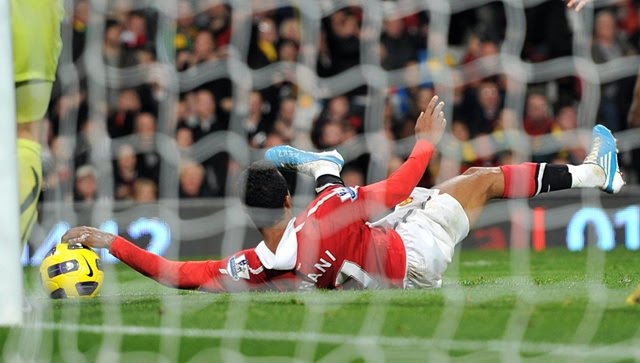
Fair Play Award for Nani

A bit close to the bone this one, but why do most of the cheaters in world football come from a Hispanic or Latin American background?
For years we have listened to stories of cynical tactics and blatant attempts to fool referees and intimidate opposition players - Argentina 1966, Athletico Madrid in 1974 and Maradona 1986, spring immediately to mind. And then this weekend, when Ricky Villa is quoted as admitting that a little bit of cheating is acceptable in Argentinian football, we have this little prick Nani doing it when it is most serious - against Spurs. And of course while we're on the subject of United, we also think of that thankfully-departed-from-the-Premiership-toad, Ronaldo. Thanks be to fuck that he's back in La Liga.
We need a few more like this - you see there are a few good ones.
Tuesday, September 28, 2010
Nearer my God to thee
Inda Kinny’s appalling lack of judgement on the issue of pairing this week, and Labour’s triumphalism at their timely interjection, is another fine example of how fucked up this country’s political system is.
Why can’t all these morons realise that most of the rational people in the country don’t give a shit about who did what at Beal na Blath, or who was licking the stamps at the GPO in Easter Week. We want to bury the Civil War politics that have blighted this country for so long and we want leaders who will make decisions based on the common good rather their party’s perceived electoral standing.
It’s akin to the crew of the Titanic fist-fighting to decide who should get the prime position on the captain’s bridge to observe the Milky Way.
Wankers.
Saturday, September 11, 2010
Shrek at Everton
All the hullabaloo about Wayne Rooney's extramarital activities, and his lack of respect for the England supporters at the World Cup, hide the truth behind why his return to Goodison today would have been such a torrid affair.

The reason why Rooney is hated on Merseyside goes back to Hillsborough and his subsequent decision (admittedly several years later) to sell his story in an exclusive to "The Sun", the newspaper which had lied and made scurrilous observations about the behaviour of the Liverpool fans on the day of the Hillsborough disaster.
From the Guardian in 2004:
"The 18-year-old's decision to sell his life story - 'world exclusive' - revelations that he and his fiancĂ©e love each other, watch EastEnders and have a dog called Fiz - for £250,000 to the Sun and its sister paper, the News of the World , was guaranteed to test his folk hero status like nothing else. As in 1992, when Liverpool manager Graeme Souness took the paper's shilling, radio phone-ins were jammed. Fans wrote letters or emails saying they were 'sickened'. Red-blue rivalries on the field were irrelevant: Everton and Liverpool fans are united in hatred of the Sun.
Leading the condemnation of the deal is Jimmy McGovern, writer of the TV drama documentary Hillsborough. He said last night: 'Footballers today are on massive wages because 96 fans died at Hillsborough and Lord Justice Taylor had to drag the game into the modern era. Footballers should never forget it. Local lads especially. Locally born footballers have an enormous responsibility to the Hillsborough dead. That is hard, I know. They are only young men. But, tough, they have it. So for Wayne Rooney to sell his story to the Sun is a disgrace.'
It was nice to see Everton's comeback knock the wind out of United's sails today with the two late goals. It was an awful shame Rooney wasn't there to do the walk of shame to the dressing room after the game. Hopefully, hopefully - another time.
Tuesday, August 24, 2010
What a difference you made

I’m on a roll now about churchdoor’s favourite anti-heroes. Most recently Joe Cole and now Stephen “I’ve got two dead Grannies” Ireland.
Last Saturday’s papers were festooned with articles featuring this imbecile criticising Manchester City (normally a very sound thing to do I admit) and specifically accusing them of a lack of loyalty in not retaining his services. In the following day’s papers he gives the FAI and the Irish National Team the same treatment and defiantly declares that he will play for his country again.
Is it possible that his comments about Manchester City were something to do with the fact that he had prolonged negotiations with them over a £2 million contract severance payment and in the end had to accept a paltry £1.5 million. Is he a little bitter perhaps?
How can this man accuse anyone of a lack of loyalty when he himself has turned his back on his country – whom he represented at U15, U16 and U17, arguably his formative years – and treated his own family with an appalling lack of respect, inventing stories about their deaths to suit his own pathetic and self-centred needs.
Sadly he will probably go on to forge a decent career at Villa but you have to admit it was lovely to see him on the back-end of a 6-0 drubbing on his Villa debut at Newcastle on Sunday. Well done Stephen, not many footballers can achieve that – you must have been pulling your hair out at the end of the game.
Friday, August 20, 2010
Cole rejects Spurs and is Spot On at Liverpool
Sunday, August 15, 2010
Cole rejects Spurs and chooses Red of Liverpool
Subscribe to:
Posts (Atom)